


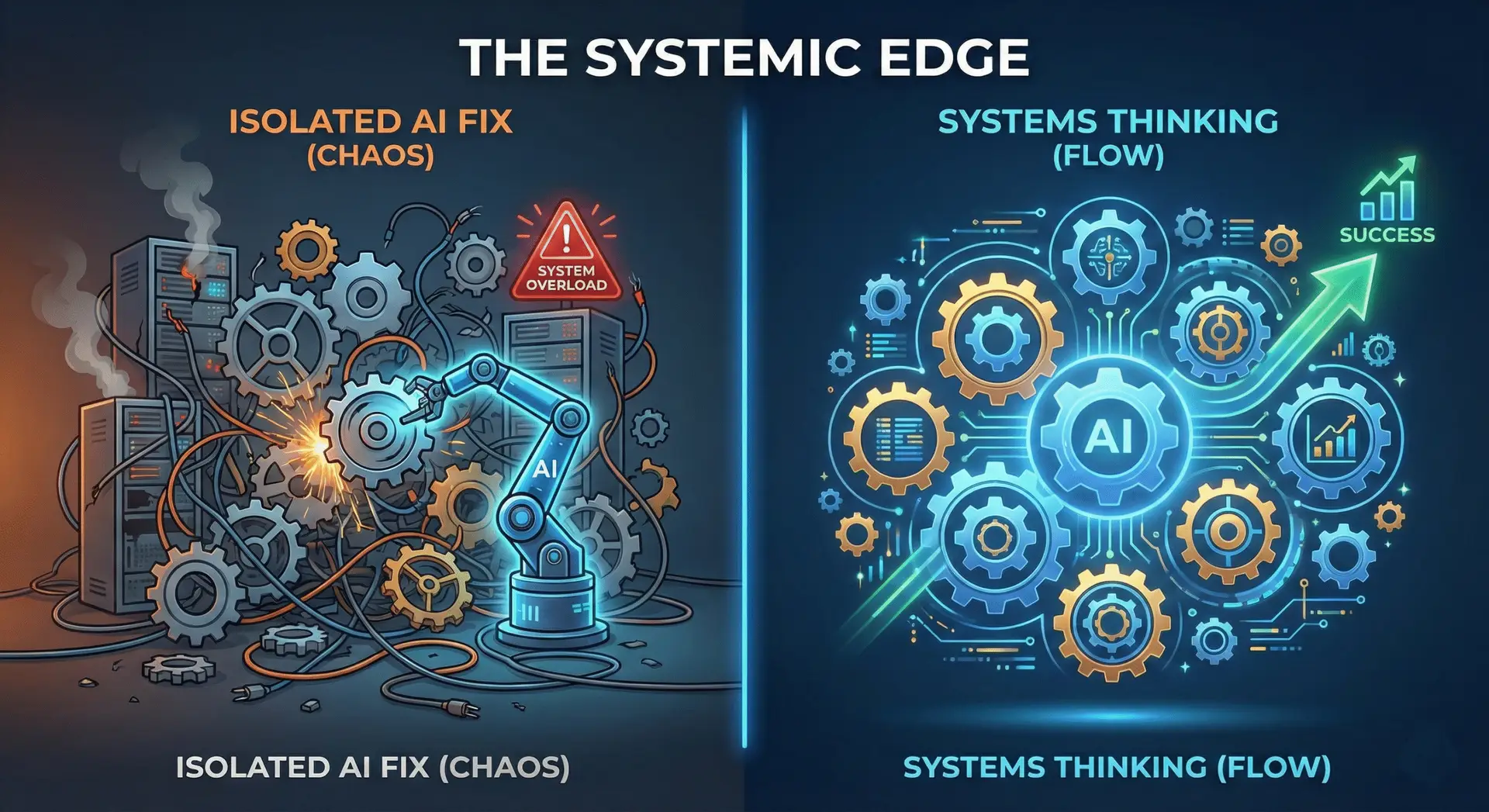
The Systemic Edge: Why AI May Fail Without Systems Thinking
If you are a leader evaluating your current operations, you likely see a dozen places where AI could “fix” a bottleneck.
But here is the reality that often goes unsaid in the boardroom or the executive leadership meeting: Optimizing a single task with AI without considering the whole system is a recipe for expensive chaos.
As a business leader, the pressure to “just do something” with AI is immense. You are told that speed is everything. But the paradox of digital transformation is that moving fast on a broken foundation only gets you to the wrong destination more quickly. If you feel hesitant to give the “green light” on a major AI process improvement, that isn’t a lack of innovation—it is likely your intuition telling you that there are significant unknowns.
A simple definition of systems thinking is the practice of looking at the “big picture” (the macro) by focusing on the interconnections between parts, rather than just the parts themselves. While traditional thinking attempts to solve a problem by breaking it down into smaller, isolated pieces (micro), systems thinking looks at how those pieces interact and influence one another over time.
Do you think your team is ready for the shift to deploying enterprise AI?

