


AI Anxiety in the C-Suite: Leading with Wisdom in an Automated World
If you are sitting in a boardroom right now, there is a good chance the elephant in the room is spelled “AI.”
But here is the reality few are admitting: You aren’t just worried about how to use AI; you are worried about what it means for your purpose.
As a C-level leader, you are being bombarded with conflicting narratives. On one hand, you’re told AI is an existential threat if you don’t adopt it yesterday. On the other, you’re warned about ethical gray areas, data privacy, and the erosion of human connection. This perplexingly paradoxical challenge may lead to paralysis. If you feel overwhelmed by the pressure to have an “AI Strategy” before you fully understand the implications, you aren’t alone.
The goal of this article isn’t to teach you how to code. It is to help you lead with discernment.
The Context: The “Hard” Reality
Let’s look at the technical landscape. Generative AI has moved faster than any technology cycle in history—faster than the internet, faster than mobile.
The barrier to entry has dropped to zero. Your junior employees are likely already using these tools, possibly creating “Shadow IT” risks you can’t see. The market is flooding with vendors promising that their AI solution will solve your efficiency problems.
The Trap: The most common mistake I see organizations make is treating AI as a Procurement Event. Companies rush to buy an enterprise license, thinking the purchase is the strategy. But buying a treadmill doesn’t make you an athlete. Deploying AI without a governance framework or a clear moral compass is just accelerating chaos.
The Pivot: A Question of Stewardship
This is where the conversation usually stops—at the technical level. But to be a true leader, we must go deeper. The resistance you see in your C-suite peers—the skepticism, the stalling, or the reckless speed—is rarely about the software. It’s about alignment.
We have to filter these new capabilities through a lens of values. When we look at AI, we must ask: Does this tool serve our people, or are we asking our people to serve the tool?
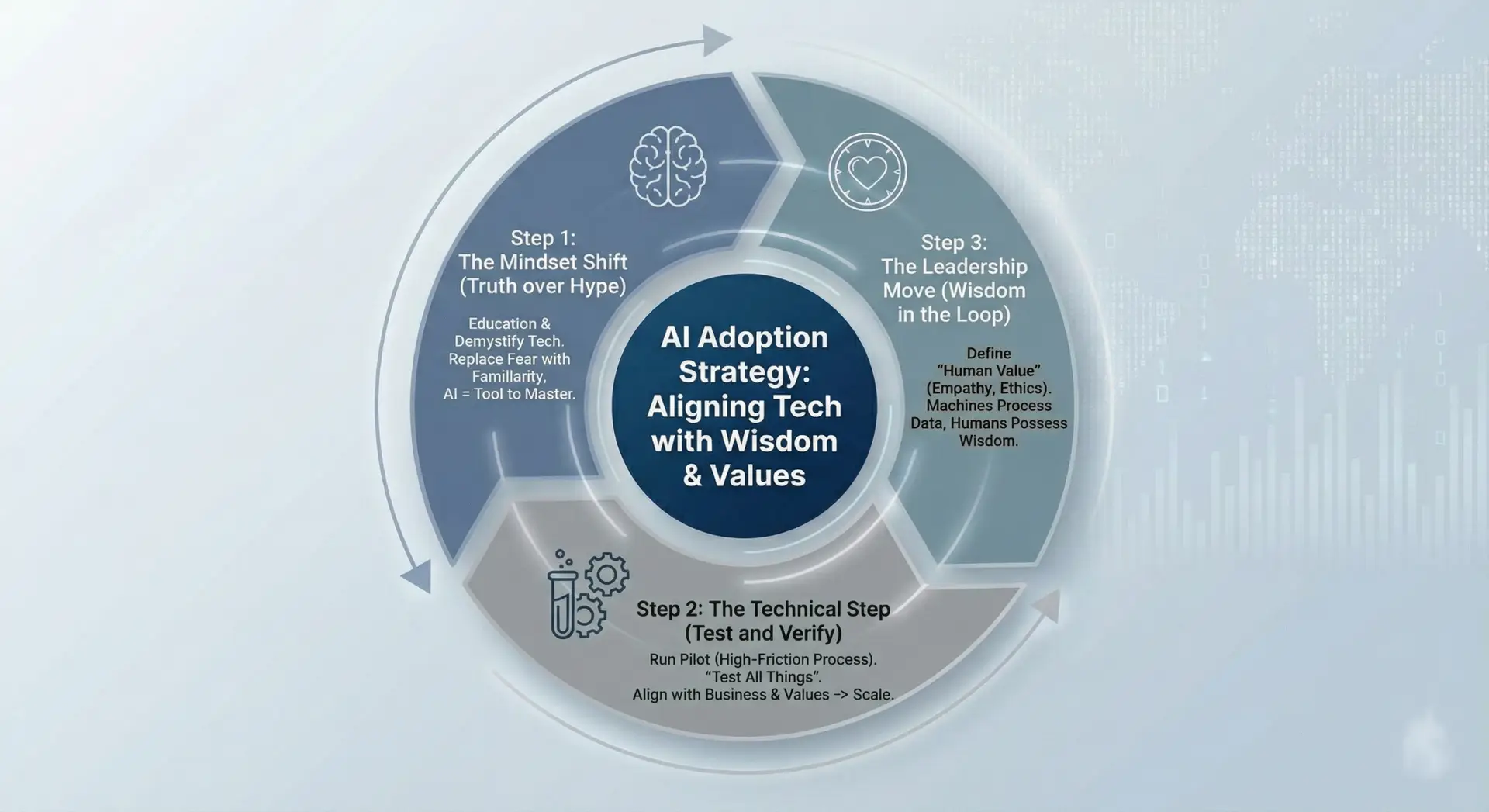
There is a concept I live by: test everything. If a new technology aligns with truth, integrity, and the upliftment of others, we should be “all in.” We should innovate boldly. But if a use case creates deception, cuts ethical corners, or devalues the human contribution, we do not need to condemn the technology itself—but we must stop and have a serious discussion.
-
Status Quo Bias: We often fear AI because it threatens the current systems that pays our bonuses. But are we holding onto old ways because they are right, or just because they are comfortable?
-
Identity Threat: Leadership has traditionally been about having the answers. In an AI world, leadership is about asking the right questions. We are shifting from being the source of knowledge to being the stewards of wisdom.
If you don’t address this foundational layer, your expensive AI implementation will fail. Your team won’t trust the tools if they don’t trust the motives behind them.
The Assessment: Auditing Your Foundation
Before you spend another dollar on technology, assess your leadership dynamic. We need to move from anxiety to clarity. Ask these three questions in your next strategy meeting:
1. The “Why” Test (Purpose) Can every member of the C-suite articulate why we are adopting AI in one sentence? Is it solely for profit efficiency, or is it to free up our people for higher-value work? If the motive is purely transactional, relationships will fracture, therefore, the culture will fracture.
2. The Safety Check (Protection) Do we have a “safe harbor” environment where employees can be honest about how they are using these tools? If people are hiding their usage, you cannot guide them. Light reveals; darkness hides risks.
3. The Ego Check (Service) Are we willing to let AI automate tasks we used to consider “strategic,” or are we holding onto old workflows out of pride? True leadership is service. If a tool can serve the client better and faster, our ego shouldn’t stand in the way—provided the integrity of the work remains intact.
Conclusion
AI anxiety in the C-suite is normal, but staying frozen is not an option. The companies that win in this era won’t be the ones with the fastest algorithms; they will be the ones with the strongest foundations.
Automation is easy; leading people through it with integrity is the hard part. We don’t have to fear the future if we are grounded in the principles that matter.
The Next Step: If your leadership team is stuck in the “analysis paralysis” phase of AI adoption, or if you are concerned that your tech strategy is drifting away from your core values, let’s have a discussion. I offer a Readiness Assessment that reviews your IT infrastructure and your organizational mindset to ensure you build a strategy that will last.

